



Is Basic Democracy Enough?


The difference between democracy and autocracy is not always a question of black and white, but sometimes about shades of gray. The United States, for example, prides itself on a long democratic tradition, but many of its minority citizens were effectively barred from voting until the Civil Rights movement of the 1960s. Similarly, the United Kingdom was an early democratizer in Europe, but historically many of its Members of Parliament were appointed based on their connections to the monarchy rather than elected and this system’s legacy lives on in the House of Lords. Parliaments and other political bodies in many countries have been based on these “mixed” systems where some fraction of seats were chosen by election and the rest based on a non-electoral process.
Many papers in economic find that elections have major governance benefits, even in the case of local elections within a non-electoral system nationally. Elections allow citizens to contribute their collective knowledge to improve policy and hold underperforming politicians accountable. These strengths lead democracies to invest more in public goods, resulting in higher rates of long-term economic growth. However, the logic is less clear in the electorally mixed systems described above. On the one hand, increasing the fraction of elected politicians could still produce these benefits, perhaps in proportion to the use of elections. On the other hand, mixed systems may only offer a ceremonial role for elected members, leaving real power concentrated in the hands of unelected powerbrokers, either those on the council or those who selected them. A final option could be one of miscoordination: elected politicians perform well in full-fledged democracies, but their different incentives and perspectives with unelected authorities leads to friction. In these cases, increasing the fraction of elected politicians could actually reduce a government’s effectiveness.
Ayub Khan’s “Basic Democracy” System
In my paper “Is Basic Democracy Enough?”, I study this question in the context of local government in Pakistan in the 1960s. This period is known as the “Basic Democracy” system in Pakistan and was designed by General Ayub Khan after his ascension to the presidency in 1958. Although Khan did not come to power electorally, he was nonetheless promoted local democracy by creating the first version of Pakistan’s union councils. Each council typically served around 10,000 people and was a mixed body formed of roughly two-thirds elected members and one-third appointed members. The latter group was selected by district officials in Khan’s government, “often with the recommendation of police, education, and other officials (Ashford 1967).
The Basic Democracy system is a helpful setting to study the effects of elections in “gray area” systems for two reasons. First, the system was truly a mix of electoral and non-electoral influences. Formally, councils had wide control over rural development projects, typically in areas such as schools, health clinics, or agricultural improvements. Elected members also formed a supermajority on the council, meaning they could theoretically control its functions if they were sufficiently coordinated. Elected members were more representative of the council’s population than traditional authorities, meaning the system offered real potential for political change. However, these councilors operated in a system where unelected district officials retained veto power over the projects and pre-1960 leaders were granted influence through the selective process of appointing members and informally through their elevated status. In short, these early union councils faced the same head- and tailwinds as those of partially electoral systems.
Correlation vs. Causation
The second reason to study the Basic Democracy system is statistical: a quirk of the rules establishing the councils offers a way to disentangle correlation from causation. In normal circumstances, the extent to which a non-democracy uses elections is a highly politicized decision. Comparing outcomes in cases where more seats were elected to those where few seats were elected risks confusing preexisting political differences with the effects from elections. In the Basic Democracy system, however, the number of elected and appointed seats was determined by formula. First, the population of the council determined the number of elected members, with one per 800 people. Then, the number of elected seats was halved and rounded down to calculate the number of appointed seats. For example, a council with either six or seven elected seats would have three appointed seats. A council with eight or nine elected seats would have four appointed ones.
In my paper, I use this rounding as a source of “as good as random” changes to councils’ ratio of elected to unelected members. Although elected members always formed a council supermajority, their proportion was affected by the rounding procedure described above. A council with an odd number of elected members “loses” half an appointed member from rounding down while one with an even number would not. Thus, “even-numbered” councils always have an elected/appointed ratio of 2:1 while “odd-numbered” councils have a higher ratio, 2.23 in my data. This causes the elected/appointed ratio to bounce up and down in a highly artificial pattern, as shown below.

The rest of the paper compares villages in odd- and even-numbered councils to see if to find similar up-and-down patterns in their future economic development. It argues that odd/even differences were unlikely to occur naturally. Instead, they could only occur because the formula’s rounding shaped how council members obtained their seats.
Data Collection
Alongside an excellent team,1 I collected several sources of historical data including council delimitation boundaries printed and village-level economic information from Pakistan’s censuses. The process involved obtaining scans of the original documents from libraries in both the US and Pakistan and then entering the data in a machine-readable format.
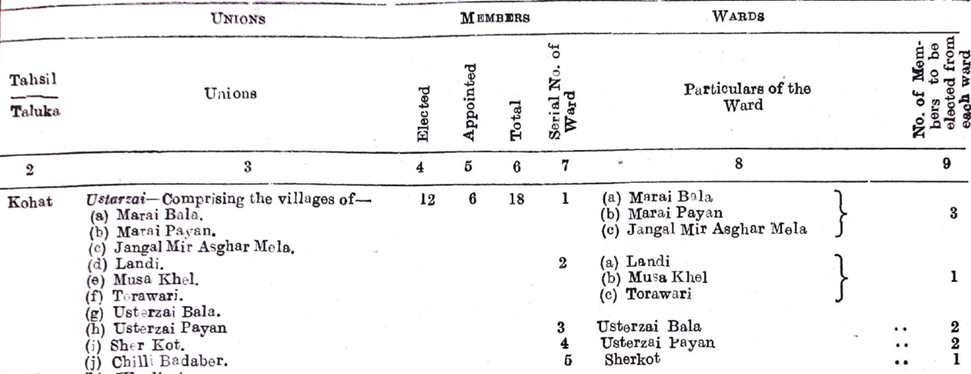
Figure 1: Union Council boundaries and member composition, Gazette of West Pakistan
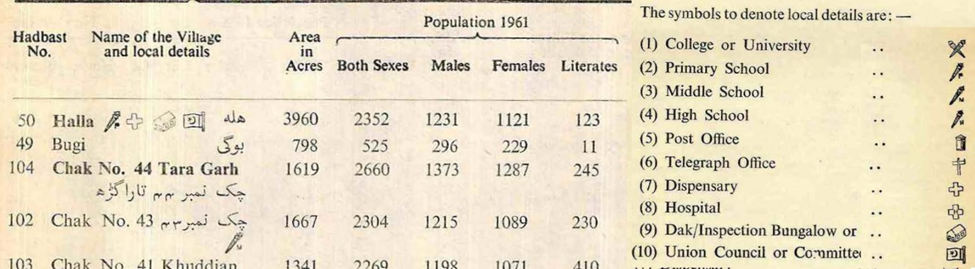
Figure 2: Village population and economic features in the 1961 census
Elections and Council Projects
I use the odd/even comparison to assess how a shift toward elections affected union councils’ actions. In census data from before the councils were created, villages in odd- and even-numbered councils have similar levels of public goods such as schools (Table 3 of the paper). However, in the 1972 census following Ayub Khan’s presidency, their paths diverged. Villages in odd-numbered councils had more elections but had fewer village public goods than their counterparts in even-numbered councils. The pattern, shown below, was the mirror opposite of the alternating pattern of the elected/appointed ratio. The similarity between the two figures strongly suggests that increasing elections on the council reduced its inclination for public works. This, in turn, reduced long-run measures of economic development as based on measures from the mauza census of 2020 (Table 6 of the paper).
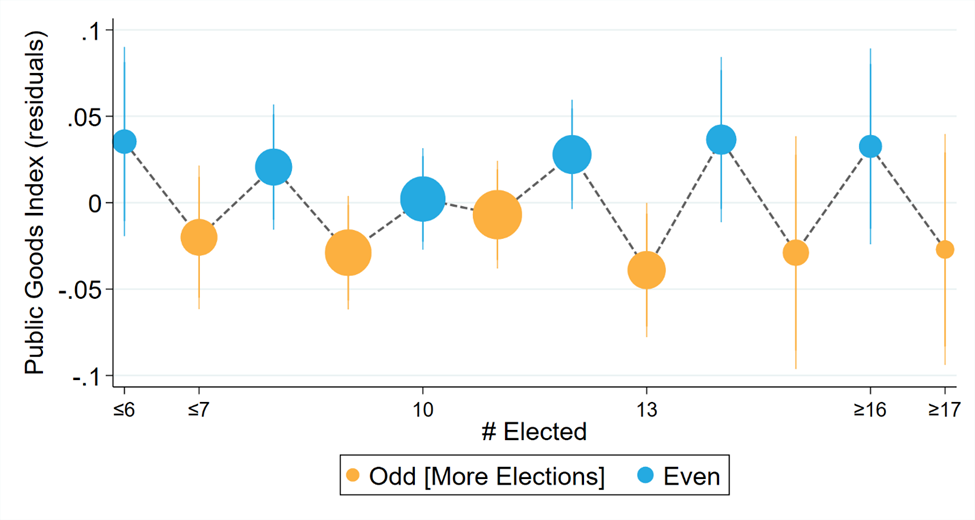
Both the changes in representation and development outcomes are small, but they are detectable given the large, national-level sample of my data. In contrast to the idea that the elected council members had a purely symbolic role in the councils, this means that their proportion in the council mattered. However, the reduction in public works and resulting impact on development means that they performed less effectively in this setting relative to the expectations set by research on larger expansions of electoral power.
Why did this happen? Contemporary documents suggest that elected councilors often faced resistance from traditional sources of political authority, including large landowners. A training manual from the period describes how this group was “not prepared to cooperate with the majority” of elected councilors who represented different groups, including smaller landowners and educated professionals (Akbar 1960). The larger landowners, along with the appointed members of the council, successfully resisted the passage of a local tax to pay for school construction, illustrating how these frictions could impede council activity. I find support for this dynamic in my data: odd-numbered councils experience higher rates of resignation or expulsion of council members, indicating disagreement or disengagement.
Other explanations for the results are less promising. While the central government could have provided less support to councils with more elected members, the data on projects conducted by the center show no detectable differences. Similarly, the elected council members were not politically marginalized. Elected members were about twice as likely to head the council as its chairman and they were more likely to retain political power in the later union council terms.
Conclusion
In many settings, transitions toward or away from electoral democracy unfold gradually, through the accumulation of small changes rather than abrupt shifts. In contrast to research examining complete democratic transitions, this study finds that smaller shifts “on the margin” can actually reduce a council’s ability to provide for its constituents. Based on a mix of qualitative and quantitative evidence, elected councilors in the Basic Democracy period were relatively successful in their own political careers, but they had less success in the political coordination necessary to navigate the mix of electoral and non-electoral sources of influence to achieve political consensus. While caution is always warranted in extrapolating dynamics from one setting to another, the divergent results here suggest that the path toward full democracy is not always straightforward and halfway measures may not be enough to improve how well a government functions.
1I am grateful to Rizwan Maqsood, Ali Asad Sabir, Muhammad Shahmeer, Luna Paz Bratti, Naseer Ahmad, Fateh Farhan, and Jasur Cosby for excellent research assistance.
The Friday Economist is a collaborative blog series between the Mahbub Ul Haq Research Centre and the Chaudhry Nazar Muhammad Department of Economics at LUMS.

Cory Smith
Mahbub ul Haq Research Centre at LUMS


Postal Address
LUMS
Sector U, DHA
Lahore Cantt, 54792, Pakistan
Office Hours
Mon. to Fri., 8:30 a.m. to 5:00 p.m.