



Skills, Cities and Gender: What Affects Freelance Earnings in Pakistan


Pakistan is ranked among the world's top freelance markets with 2.3 million freelancers and $1.6B revenue a year. Much of its appeal lies in being a low-barrier, location-independent alternative to formal employment. That matters in a country whose labor market faces roughly two million new entrants each year that it cannot entirely absorb. The strain is sharpest among the educated: more than 31% of degree-holding youth are unemployed, and women make up over half of all the jobless, with female graduates nearly four times as likely to be out of work as their male peers. Against that backdrop, freelancing has stepped into the gap as a lucrative safety net.
But the promising headlines around freelancing say nothing about who earns well and who barely earns at all. Further, is freelancing really low-barrier and location-independent for everyone? That is the question we set out to answer: among Pakistani freelancers, what really affects earnings: efficiency, experience, skill, location, or gender?
We studied the profile data of more than 16,000 Pakistani freelancers on Upwork and Freelancer.com (two of the largest and most accessible platforms) modelling log of total earnings against skill category, city, platform, performance signals and gender. Four patterns stood out.
Some skills pay far more
What a freelancer does is one of the strongest indicators of what they earn. The best-paid skill categories are Accounting and Consulting, Software Development, and Web Development, where freelancers average roughly $30,000–35,000 in total earnings (Figure 1). After controlling for platform, city, and gender, and keeping Design and Creative category as baseline, Software Development pays 46% more, Web Development 40% more, and Accounting and Consulting 32% more than Design and Creative. Indeed, Pakistan is ranked 4th in the world for Software and Technology exports in freelancing. Game Design has the highest average earnings of any category, over $45,000, and pays around 67% more than Design and Creative after controls are applied; though it covers only about a hundred freelancers. Writing, Marketing, and Engineering and Architecture earn about as much as Design and Creative, while two fields earn substantially less: IT and Networking by about 36% and Legal work by about 48%.
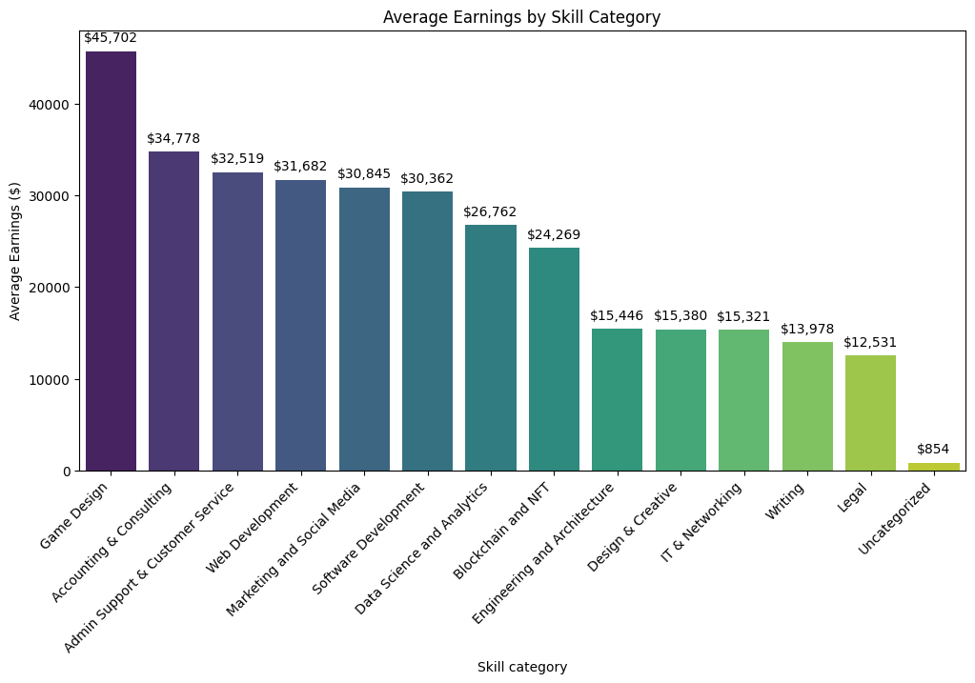
Figure 1: Average total earnings by skill category, combined dataset. Source: Authors' calculations.
These income differences sit on top of a very uneven supply of talent (Figure 2). Just four crowded skill domains: Web Development, Design and Creative, Marketing, and Writing, account for about three-quarters of all the freelancers in our sample. The better-paid specialisms are comparatively in short supply: Accounting and Consulting, Data Science, and Engineering each make up only ~ 4% of freelancers in our data, with Game Design, IT, Legal and Blockchain <1%.

Figure 2: Number of freelancers by skill category, combined dataset. Source: Authors' calculations.
This is where AI enters the picture. Generative AI is eroding demand for exactly the high-volume, lower-complexity work many Pakistani freelancers in our data were doing. This is in line with a Harvard-led study that found that writing job posts on Upwork and Fiverr fell about 30% in the eight months after ChatGPT's release, and Upwork's own data shows AI cutting demand for writing and translation while raising earnings in higher-value fields like data science. Yet, skills like data science, machine learning, and analytics were in short supply in our data, and even those freelancers earned only middling amounts, suggesting the country's expert AI talent pool is yet to meet global demand. That scarcity is not unique to Pakistan: worldwide, demand for AI talent runs at roughly three times the available supply. Pakistan is, our data suggests, yet to catch up with the rising demand of more technical and high-paying skills.
A persistent gender gap
Out of the 16000 freelancers in our data, only 15% were women, and once we accounted for gender, we discovered a significant gender pay gap and probably something the World Bank has framed as ‘Confidence Gap’. Firstly, women’s total earnings were about 20% less than men after controlling for skill, city and platform (Figure 3). Secondly, men charged an hourly rate of $19 on average, while women charged ~$16; the $3.4 difference being statistically significant. This agrees with recent studies: Foong et al. found the median woman on Upwork set her hourly rate at just 74% of the median man's, a gap left unexplained by job category, experience or education, while the World Bank attributes a similar discrepancy to a tendency for women to "ask for less" due to lower confidence and expectations.
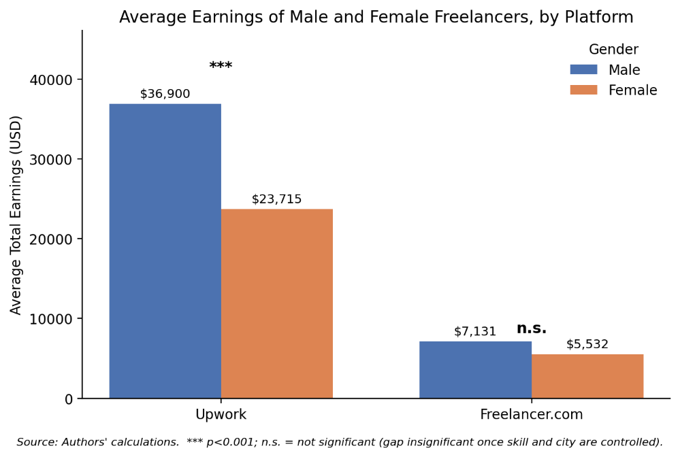
Figure 3: Average earnings of male and female freelancers, by platform. Source: Authors' calculations.
Part of this also reflects how men and women sort across fields. As Figure 4 shows, women cluster in the crowded, lower-paid categories: writing, design, marketing, and remain thinly represented in high-earning technical ones like software development and data science. This pattern mirrors occupational segregation in the offline labor market and the wider online gig economy.
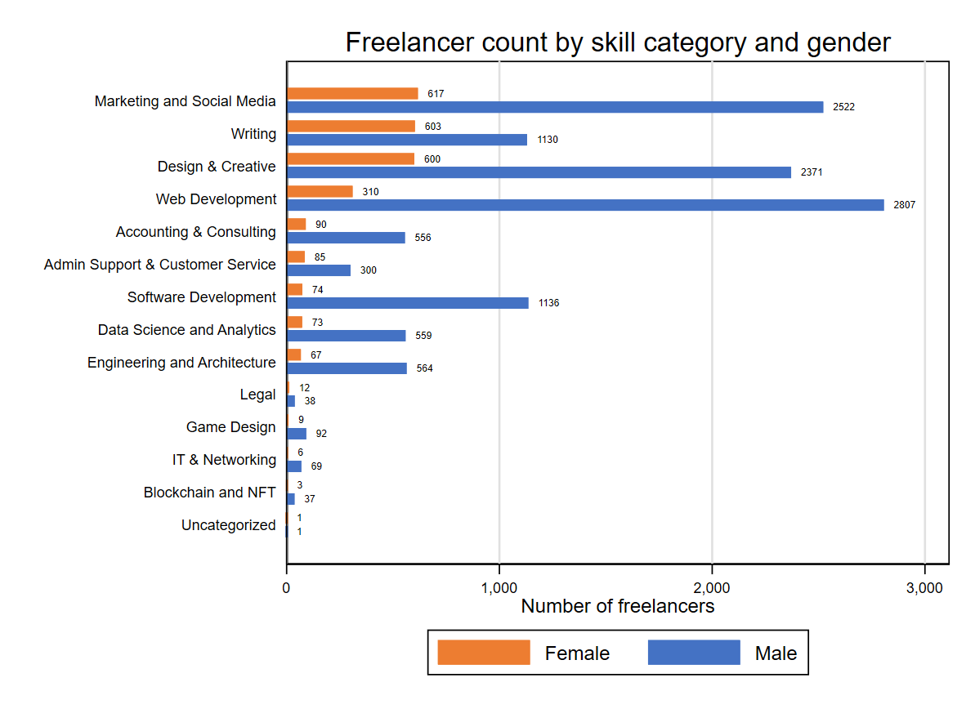
Figure 4: Freelancer count by skill category and gender. Source: Authors' calculations
The earnings gap persisted, however, even within the same fields: on Upwork the median woman in Web Development earned about $7,800 against $14,400 for men, and in Software Development roughly $7,200 against $16,800. Because these were comparisons within the same field, the gap must have come from somewhere else — women winning fewer or smaller contracts, pricing lower, building up ratings more slowly, or carrying domestic duties that cap their hours. The World Bank documents the same residual on a global freelancing platform — roughly a 10% gap in quoted hourly rates.
The geography paradox
One of our most striking results from our analysis is geography, and it is surprising precisely because freelancing is spatially flexible. In contemporary literature on freelancing, though, remote work is often expected to follow the patterns of offline employment in terms of location: large-scale studies of platforms like Upwork, Fiverr and Freelancer.com find that capital-region workers in the Global South earn around a third more per hour than freelancers elsewhere in less developed cities. They attribute this to the agglomerative forces linked to the unequal spatial distribution of skills, human capital, and opportunities. On that logic, we expected Pakistan's largest, most developed cities, Karachi, Lahore, Islamabad, to have the highest average total earnings, through denser networks, better infrastructure and larger pools of skills and clients. Recent accounts of Pakistan's freelance economy point the same way, placing the bulk of the country's freelancers and earnings in centers like Karachi, Lahore and Islamabad.
Our data, however, tells a different story: smaller, less developed cities earned more than larger developed cities. Of the 167 cities in our sample, 68 had at least 20 freelancers, to be compared against Karachi, the baseline city. Out of those, 27 smaller cities earned significantly more than Karachi, while only nine earned less. Abbottabad, Attock and Jhelum were the highest earning cities in our data (Figure 5). Karachi's median freelancer earned only about $1,700, whereas the medians in Abbottabad and Attock were roughly $33,500 and $28,000.
Holding skill, platform and gender constant, freelancers in Abbottabad earned roughly nine times as much as those in Karachi, and Attock about seven times as much (both p<0.001); Jhelum, the third city highlighted in Figure 5, earned around three and a half times more (p<0.001).
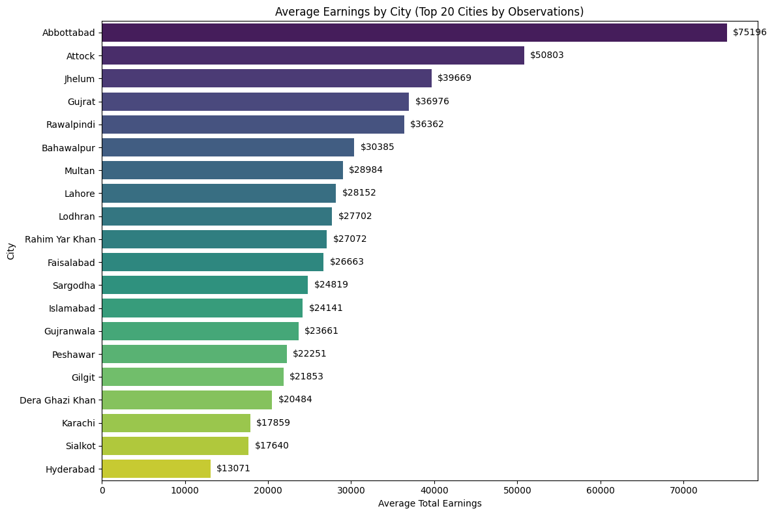
Figure 5: Average total earnings in $ by city (top cities by number of profiles), combined dataset. Source: Authors' calculations.
So even on a global, spatially flexible marketplace, location still affects earnings. Part of that explanation comes from a few studies. A US freelancing study has shown that rural and smaller regions can make disproportionate use of online platforms, and that the online labor they supply is, on average, more highly skilled than that coming from cities because freelancing lets capable people in places with few formal job openings reach global clients without having to move. Pakistan fits that logic well: formal employment is scarcer outside the major cities, so online work may be channeling exactly this kind of talent into global markets. And although the small-city freelancers in our data are not clustered in the very highest-end fields such as data science or AI, many of them work in web development (one of the best-paid categories overall) so strong earnings follow naturally.
These patterns open a valuable question for future research: why do freelancers in Pakistan's smaller cities earn so well, and what would it take to spread that success further? Pursued with richer city-level data and a closer look at who takes up freelancing, who stays, and in which skills, the answer could help policymakers and training programs raise freelance incomes in small towns and big cities alike, and build a more rigorous, ground-rooted understanding of an emerging digital economy that is already working wonders for Pakistan.
And reputation beats experience
A final pattern is that the performance indicators affecting earnings differ by platform: on Upwork, efficiency was associated with higher earnings more than experience, while on Freelancer.com experience mattered more. On Upwork, a freelancer's job-success score (our proxy for efficiency) was a powerful driver of earnings: a 0.1 rise in the score was associated with roughly 37% higher total earnings, holding skill, city and gender constant. Their hourly rate charged (proxy for experience), also increased earnings but more modestly, by about 4% per extra dollar charged (Figure 6). On Freelancer.com, however, our efficiency signals were weak: the number of reviews were associated with 0.3% higher earnings per review, while jobs completed on time had no significant impact on earnings. The experience signals, by contrast, both paid off: earnings rose about 1.4% with each extra dollar of hourly rate and about 7% with every ten-point gain in repeat-hire rate, so on this platform a strong rate and a base of returning clients are crucial.
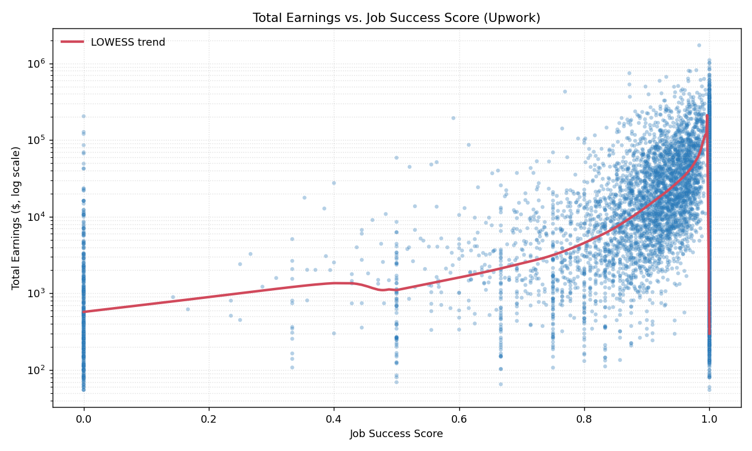
Figure 6: Total earnings versus job success score on Upwork. Source: Authors' calculations.
Where this leaves us
Our analysis and recent literature suggests that universities and training programs should pivot toward AI-complementary fields like data science and machine learning that command higher earnings and are in high demand. As skills like writing, design, marketing (which were offered by the majority freelancers in our data, especially women) are both the low-paid and the most exposed to automation, teaching and vocational training institutes should expand their portfolio of skills programs towards emerging technical fields. For platforms like Upwork, fairer visibility, rate transparency and easier re-entry after career breaks could narrow the gender gap that skill-expertise alone is not closing.
For policymakers, the priorities are to extend training and connectivity into smaller cities, to treat the gender gap as a measurable problem, and to invest in digital infrastructure like payment access, fair taxation, and internet access that still hold freelancers back. Bodies like the Pakistan Freelancers Association have begun this work: they’re partnering with banks to open dedicated foreign-currency accounts and payment gateways for freelancers, running training and awareness sessions, and lobbying to keep the low tax rate on foreign earnings.
Pakistan's freelance boom is real, but it is not a frictionless meritocracy. Earnings increase with reliability and specialization, fall in non-technical work AI is replacing, tend to concentrate in its smaller cities, and still tilt against women even when they are skilled and efficient. The strength of the smaller cities is the most unexpected of these patterns, and the one most worth researching: working out who freelances there, and why they do so well, could inform policy on rural-urban connectivity and employment.
Hadia Shehzad and Usama Akram are graduates in Economics (Class of 2025) from LUMS, researching Pakistan's digital labor market.

Hadia Shehzad
Usama Akram
Mahbub ul Haq Research Centre at LUMS


Postal Address
LUMS
Sector U, DHA
Lahore Cantt, 54792, Pakistan
Office Hours
Mon. to Fri., 8:30 a.m. to 5:00 p.m.