



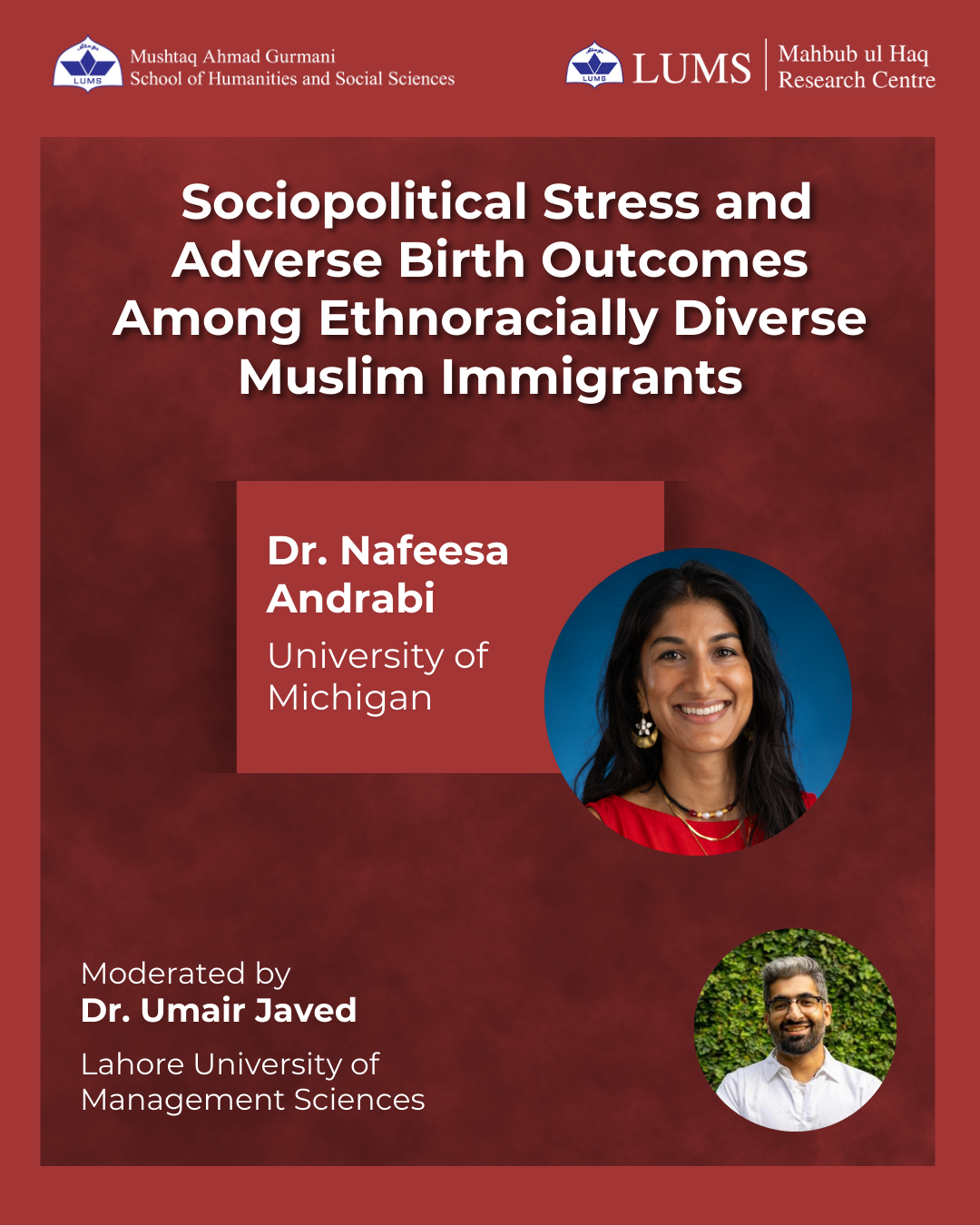
Sociopolitical Stress and Adverse Birth Outcomes Among Ethnoracially Diverse Muslim Immigrants by Dr. Nafeesa Andrabi
On 4 December 2025, in collaboration with LUMS Mushtaq Ahmad Gurmani School of Humanities and Social Sciences, the Mahbub Ul Haq Research Centre hosted Dr. Nafeesa Andrabi (University of Michigan) at LUMS to give a talk titled Sociopolitical Stress and Adverse Birth Outcomes Among Ethnoracially Diverse Muslim Immigrants. The talk was chaired by Dr. Umair Javed, Associate Professor at MGSHSS.
Dr. Andrabi began by shedding light on how her experiences in the United States led her to delve into this field of study, including the disproportionate disease burden faced by her family and other Muslim immigrants relative to other groups in the US.
She discussed terminology of identity and the issues it may bring: anti-Muslim racism or Islamophobia, the black-white binary, and how Muslim and MENA are terms often conflated in the US.
She spoke about how despite Trump’s racist and xenophobic policy prescriptions and rhetoric affected those who came unfavorably under it, if the groups in question lived in a county that consistently voted Democrat, they were still somewhat cocooned and not as affected by it as their counterparts in red counties – clearly showing that leaning blue at the county level helps minimize stress. Pivot counties, on the other hand, were an interesting area that enabled measurement of sociopolitical stress, because one could study levels of stress before and after the county in question changed political tendencies.
She reflected on the gaps in data she came upon: for example, she found no data on immigration status (e.g. who came to the US as refugees), which is a critical factor in stress profiles.
Because she spoke about the crucial role of pregnancy in her study, questions from the audience included one on the role of social support during pregnancy, to which Dr. Andrabi responded that immigrants have very low levels of social support during pregnancy and are often isolated – unless they live among other immigrants in a community or family system – and this contributes to more unfavourable outcomes. In contrast, in Pakistan, for example, there might be higher rates of preterm birth and so on, but it might be offset by an abundance of social support. An example Dr. Andrabi gave to illuminate this is that, in the US, women sometimes return to work as soon as five days after giving birth.
She also presented a portrait of the Muslim immigrant mother population in the US. This included the use of Medicare, which she explained is a proxy for low income.
Mahbub ul Haq Research Centre at LUMS


Postal Address
LUMS
Sector U, DHA
Lahore Cantt, 54792, Pakistan
Office Hours
Mon. to Fri., 8:30 a.m. to 5:00 p.m.